Webinar-The Listening Program and Autism Spectrum Disorders

If you have an interest in learning more about The Listening Program® method of music listening therapy please join me for a live webinar this Sunday organized by the Akhil Autism Foundation.

The Listening Program® (TLP) is a music listening therapy that provides engaging brain stimulation to improve performance in school, work and life. This introductory webinar is free and will provide an overview of  the auditory system, auditory processing, and how music listening therapy can help improve the life of a child on the autism spectrum.

Date: Sunday, Dec. 20, 2009
Times: USA  11:00 AM – 12:00 PM EST (Eastern Standard Time)
9:00 AM – 10:00 AM MST (Mountain Standard Time)
India    9:30 PM – 10:30 PM IST (Indian Standard Time)

TO REGISTER: https://www2.gotomeeting.com/register/790568674

After registering you will receive a confirmation email containing information about the Webinar.

SYSTEM REQUIREMENTS
PC
Required: Windows® 2000, XP Home, XP Pro, 2003 Server, Vista

Mac
Required: Mac OS® X 10.4 (Tiger®) or newer

Music Program Helps Children with Down Syndrome

Hearing and speech are common challenges for children with Down Syndrome or Trisomy 21.  Susceptible to chronic ear fluid and infections, auditory development is a crucial area of  focus when taking a comprehensive approach to helping these children reach their innate potential.

If hearing is impacted, so is  listening, auditory processing,  receptive and expressive language, and cognitive function. One broken link in the chain creates a domino effect in terms of  development of learning, behavior and communication.

Music listening therapy is a viable intervention for children with Down Syndrome. We have seen wide and varied success with The Listening Program® over the years, with the greatest success when the music is provided with a specialized audio system we developed called the ABT Bone Conduction Audio System™  that connects to an iPod or portable CD player and delivers the music simultaneously through air conduction and subtle vibrations through bone conduction. This integrated approach delivers a more reliable auditory signal to the brain helping to train it to discriminate sound and support other functions of the autonomic and central nervous systems.

A study was conducted by Gwyneth Jeyes and Caroline Newton in the UK in which a group of kids with Down Syndrome completed just half of the recommended minimum 50 hour protocol of The Listening Program® which is spread over the course of several months, with daily listening sessions of 15 or 30 minutes. These kids ages 5 to 12 yrs listened for just 25 hours and without the added bone conduction training. Even at this level of intervention all but one of the nine children showed improvements in listening, speech and language skills based on parent surveys. Other improvements were also seen in several of the children.

These results were presented in a Poster Session at the 1oth World Down Syndrome Congress in Dublin back in August. While the study is small, the outcomes are consistent with reports from Speech and Language Pathologists and other practitioners using The Listening Program® with their clients with this chromosomal anomaly.  I am hopeful that we will see interest in see a larger, controlled study.

Read or download the poster.

Mozart Soothes Premature Babies

My wife and I just returned from an appointment with our OB to check on the progress of our son Brendan who is due to arrive in January.  As an expectant father and producer of therapeutic music programs I am a huge believer in the positive benefits of exposing our son to music in utero and beyond.

So,  I just opened my email and sitting in my Inbox is a study forwarded to me by my friend and collaborator Don Campbell that demonstrates that Mozart soothes premature babies.  Now, this is no revelation for those of us in the field, but it it gratifying to see researchers continue to study the effects of music on newborns, at a time when our auditory system is most vulnerable to the onslaught of noise we are faced with as we exit the birth canal and leave the warmth and comfort of the fluid filled womb.

The Israeli study demonstrated that healthy, premature infants who listened to Mozart  had a 10-13 % reduction in resting energy expenditure compared to those with no music exposure.  The study did not evaluate other music and has not been replicated but the findings are interesting and support further scientific exploration. This study will be published in the January print issue of the journal Pediatrics. Read the story in the online edition of U.S. News & World Report.

So, when Brendan arrives will there be music to greet him? The answer is an unequivocal YES!! What will he be listening to? Well, to be honest the award-winning Music for Babies collection that I co-produced with my dear friend Richard Lawrence a few years ago. Newborn or otherwise, I can assure you Sleepy Baby and Peaceful Baby will ease the stress of your day.

New Autism Study Demonstrates The Listening Program Improves Auditory Skills

A new study in the UK demonstrates The Listening Program® developed by Advanced Brain Technologies improves auditory skills in children with autism.

“A Study to Establish Whether the Use of The Listening Program is Effective in Improving Auditory Skills for Children with Autism” was presented by Gwyneth Jeyes  at the Developmental Practitioners Association Conference “Children Matter” In Nottinghamshire, United Kingdom back in September.

Twelve children on the autism spectrum ranging in age from 5 yrs. 8 mo. to 12 yrs. 4 mo. in Northern Ireland participated in the study. Results from the SCAN-C test for Auditory Processing Disorders demonstrated improvements in auditory skills in all children who completed The Listening Program® method of music listening therapy.

The Listening Program® has been widely used for more than a decade to reduce auditory hypersensitivites, improve auditory discrimination, increase communication skills, and social engagement for children on the autism spectrum. The outcomes of this research are encouraging, consistent with other studies,  and warrant the design of  a larger, controlled study to explore the feasibility of more widespread use of this music listening therapy method to improve auditory processing skills for children with autism spectrum disorders.

To read the full study

iPod Therapy Opens Memories for Alzheimer’s Patients

Music works, music heals; it unlocks our emotions, creativity, spirituality, and the infinite potential of the brain.  It is also a way to tap into the memories of someone suffering with Alzheimer’s Disease according to Dr. Concetta Tomaino, who has studied the therapeutic effects of music for more than 30 years.

Caregivers have observed for decades that Alzheimer’s patients can still remember and sing songs long after they’ve stopped recognizing names and faces. Many hospitals and nursing homes use music as recreation, since it brings patients pleasure. But beyond the entertainment value, there’s growing evidence that listening to music can also help stimulate seemingly lost memories and even help restore some cognitive function.

“What I believe is happening is that by engaging very basic mechanisms of emotions and listening, music is stimulating dormant areas of the brain that haven’t been accessible due to degenerative disease,” says Concetta Tomaino, executive director of the Institute for Music and Neurologic Function, a nonprofit organization founded at Beth Abraham in 1995. 1

Read the complete article by Melinda Beck in The Wall Street Journal.

1Retrieved November, 26, 2009 The Wall Street Journal “A Key for Unlocking Memories” http://online.wsj.com/article/SB10001424052748704538404574540163096944766.html

We Read With Our Ears

It may sound strange but we read with our ears. A recent study at Northwestern provides clear evidence to support the groundbreaking theories developed by the late Alfred Tomatis, M.D. in the mid twentieth century about the role the ear plays in reading.

The vast majority of school-aged children can focus on the voice of a teacher amid the cacophony of the typical classroom thanks to a brain that automatically focuses on relevant, predictable and repeating auditory information, according to new research from Northwestern University.

But for children with developmental dyslexia, the teacher’s voice may get lost in the background noise of banging lockers, whispering children, playground screams and scraping chairs, the researchers say. Their study appears in the Nov. 12 issue of Neuron.

Recent scientific studies suggest that children with developmental dyslexia — a neurological disorder affecting reading and spelling skills in 5 to 10 percent of school aged children — have difficulties separating relevant auditory information from competing noise.

The research from Northwestern University’s Auditory Neuroscience Laboratory not only confirms those findings but presents biological evidence that children who report problems hearing speech in noise also suffer from a measurable neural impairment that adversely affects their ability to make use of regularities in the sound environment.

“The ability to sharpen or fine-tune repeating elements is crucial to hearing speech in noise because it allows for superior ‘tagging’ of voice pitch, an important cue in picking out a particular voice within background noise,” said Nina Kraus, Hugh Knowles Professor of Communication Sciences and Neurobiology and director of the Auditory Neuroscience Laboratory.

In the article “Context-dependent encoding in the human auditory brainstem relates to hearing speech-in-noise: Implications for developmental dyslexia,” Kraus and co-investigators Bharath Chandrasekaran, Jane Hornickel, Erika Skoe and Trent Nicol demonstrate that the remarkable ability of the brain to tune into relevant aspects in the soundscape is carried out by an adaptive auditory system that continuously changes its activity based on the demands of context.1  Click here for full article.

These findings are consistent with part of the underlying theories behind our work at Advanced Brain Technologies. This research and studies on musical training at Northwestern provides support to warrant further studies on the potential of using music listening therapy (The Listening Program®) as an intervention for struggling readers.

1 Retrieved November 12, 2009 http://www.eurekalert.org/pub_releases/2009-11/nu-nbf110309.php

What is The Listening Program?

I just wanted to share a new video released today called What is The Listening Program®? It includes interviews with professionals and others that have used this music listening therapy to improve their lives.  If you have 15 minutes please take a look and let me know what you think! Video Link

Music and the Brain: A Symposium with Integrated Live Performances

On October 30th the Cleveland Clinic Arts & Medicine Institute is presenting Music and the Brain: A Symposium with Integrated Live Performances in collaboration with Lincoln Center in New York, NY.

Neuroscience and music is an area that is finally beginning to get the attention it deserves. This symposium focuses on the relationship between music and the nervous system. It is aimed at educating physicians about this novel and unique field of “neuromusic” which studies the effect of music on the normal and abnormal physiology of the nervous system, treats certain neurological conditions using music as a therapeutic tool and treats the neurological consequences of misuse of music. It also aims at educating physicians about the status of research in the field of music and the brain.

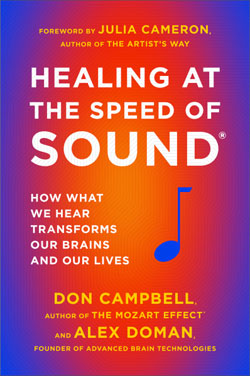
I am attending the symposium, and one of my colleagues, Vera Brandes, will be presenting a talk on the chronobiological aspects on the use of music. Vera’s company Sanoson, focuses on the prescriptive use of music as a healing modality and designs custom music systems for medical facilities.  Those of you acquainted with my work are aware that my company Advanced Brain Technologies develops neurobased therapeutic music programs: so this conference is of great interest to me, especially since I have been co-writing a book on the topic with Don Campbell (The Mozart Effect) for the course of the past year.        

For more information or to register visit http://bit.ly/3cJwiz. If you attend please introduce yourself!

Study Demonstrates Effectiveness of The Listening Program® with Bone Conduction on Children with SPD

6 children who present with sensory processing disorder (SPD) and auditory processing concerns with ages ranging from 3 yrs 11 mo. to 8 yrs. 7 mo. 4 of whom were receiving therapy services participated in the study.  Results from standardized testing demonstrated a significant improvement in all children who completed the program, compared to just therapy alone. This demonstrated that The Listening Program® with bone conduction is effective in helping increase functional skills and outcomes in children who present with sensory integration and auditory processing concerns along with skilled therapists to help achieve maximum potential and independence in everyday tasks/skills.

This study was originally presented by John Esteves at the 2008 Advanced Brain Technologies International Conference in Midway, Utah, July 2008.  A summary is in the new book just published by Springer Vienna and New York,  edited by Roland Haas and Vera Brandes Music That Works: Contributions of Biology, Neurophysiology, Psychology, Sociology, Medicine and Musicology ISBN 978-3-211-75120-6  http://www.springer.com/springerwiennewyork/medicine/book/978-3-211-75120-6

 To read or download the full study please click here.

Musical Training Helps You Hear Speech In Noise

Researchers at Northwestern University have revealed that music training may in fact help you listen in noisy environments.

Thirty-one study participants, with normal hearing and a mean age of 23, were divided into one group with music experience and another without it. They had to listen to sentences presented in increasingly noisy conditions and repeat back what they heard.

The study shows that musicians — trained to hear sounds embedded in a rich network of melodies and harmonies — are primed to understand speech in a noisy background, say in a restaurant, classroom or plane.

It is the first demonstration of musical training offsetting the deleterious effects of background noise, and the implications are provocative. 

The study points to a highly pragmatic side of music’s magic,” said Nina Kraus, Hugh Knowles Professor of Communication Sciences and Neurobiology and director of Northwestern’s Auditory Neuroscience Laboratory, where the research was done.

Better perception in noise was linked with better working memory and tone discrimination ability. The results imply that musical training enhances the ability to hear speech in challenging listening environments by strengthening auditory memory and the representation of important acoustic features.

By reinforcing the pervasive effects that musical experience has on sound-processing abilities, Nina Kraus stressed, this study underscores the importance of music education being more accessible to the general population.[1]

The Listening Program® (TLP) is a method of music listening therapy developed by my company Advanced Brain Technologies. TLP includes classical music specially arranged, recorded, and modified with acoustic features that help the listener in part, extract specific sounds from other sounds within music just as the musician does when practicing or performing.

By listening to this music with certain natural attributes psychoacoustically-modified including the mechanisms of tone, intensity, time, and space we find that listeners refine discrimination skills that generalize into practical life experiences such as listening in a classroom, restaurant, and in the work place.

This study provides further support to the theory behind our approach to listening training. Further, someone may not need to be a musician to experience such benefits but can turn to a method such as The Listening Program for the purpose of improved listening in the presence of background noise, a result frequently reported to us by providers using this approach with children over the course of the last ten years.     


[1] Northwestern University (2009, August 27). Taking Up Music So You Can Hear. ScienceDaily. Retrieved August 28, 2009, from http://www.sciencedaily.com/releases/2009/08/090817142857.htm